
Evolution of armaments and therefore war ( by consequency the art’s war / art’s
operative : A brief summary of the text from Guglielmo FERRERO (Professor of
Contemporary History at the University of Genboe ), but also from various
Wikipedia sources and history textbooks.
‘The evolution of war over three centuries’ I recap, we move from hand-held and
thrown weapons requiring skills and specific training for each type of weapon.”
- “The general forces of combatants will undergo training linked to mastery
of weapons specific to their fighting corps, as well as to their mode of
movement and combat.
a. Fighting methods differ whether on horseback, on foot, or on a ship.
b. The evolution of metallurgy and adaptation to strategy standardizes
the types of armaments and their uses.
c. An effective combatant is someone who possesses both physical
endurance, a substantial physique, and experience in close combat,
either for attacking or defending (as in the case of archers,
crossbowmen), and those who handle ballistae and heavy projectile
weapons.” - Gradual arrival of the black powder armaments known since the 19t
a. It’s a gradual integration, requiring implementation and adaptation to
combat needs, initially incendiary and defensive; the famous fire-
mouths, culverins, bombards, and various short siege cannons. b. This
technology reached England and France in the early 1300s.
b. Its use began during the Hundred Years’ War. Refer/reread Rabelais
for a detailed description of these weapons in the style of
Prévert(poetry author from the beginning 20 century)
c. Initially, these weapons required specific skills and represented a form
of prestige. Louis XI (1423-1483) possessed and utilized the mobility
of these weapons to strengthen his fortifications.
d. The breakthrough appearsed during the Renaissance, in the Italian
and Franco-Italian wars. There was an evolution marked by the
beginning of massification of combatants
e. The Spanish first then followed by the rest of the European nations,
incorporated arquebuses and muskets into their army units as
independents corps in the beginning of army’s modernization.
Consequently, a combatant with a weaker physique but good eyesight
could defeat an opponent of superior physical ability and superior
martial practice in sword and hand-to-hand combat. - “The next step, will be / as always, was the coordination of the combat
corps, a natural evolution, but three technological advancements will
appear / appeared, changing the game / change the situation , all coupled
with industrial production of quality steel. This was a period of all kind of
massifications.
The steel industry began by separating the production of iron from its
rich waste product; cast iron. The start was with the curved Puddler
furnace producing Puddled iron, then the Bessemer Furnace/Bessemer
(yielding) converter producing a high-quality steel. The problems of
sourcing charcoal and then phosphate-rich ore led to a final evolution
with many adaptations, the Siemens-Martin process.
Smokeless powder, breech-loading, the Minié ball, and rifled cannons.
These changes are often seen as evolutions. Rifle grooves were invented in
Augsburg at the end of the 15th century and improved by August Kotter, a
Nuremberg gunsmith, in 1520. Although rifled cannons date from the mid-
16th century, they did not become common until the 19th century (source:
Wikipedia).
The American Civil War (1861-65) was devastating due to the introduction
of the Minié ball (by a French officer who also developed a rifled gun) and
rifled cannons.
The American Springfield Model 1861 rifle and the British Enfield Pattern
1853 rifle, which used the Minié ball, were the most widely used firearms
in the American Civil War. Black powder and muzzle-loading were still in
use in this conflict, even for handguns which used mercury fulminate
primers synthesized in 1800. Breech-loading weapons (French invention)
became the new standard in Europe after this conflict, starting in 1866.
In Europe, under Napoleon III, the standardization of cannons that began
under Napoleon I was generalized. And it was Napoleon III who
standardized rifled cannons for heavy armaments.”
This period is a pivotal epoch due to the increasing efficiency of both weapons
and modes of production. It is also the golden age of the steam engine for
railway and naval transportation. This enabled the formation of terrestrial and
naval powers in Europe and the emerging powers in the Americas - The two world wars modified the operational art of combat by improving
both communication and the synergy of different militaries branches for
powerful and rapid actions.
The first merely set the stage for the second by generalizing what had been
achieved in the first, with three important variations: radio, aviation, and
electricity.
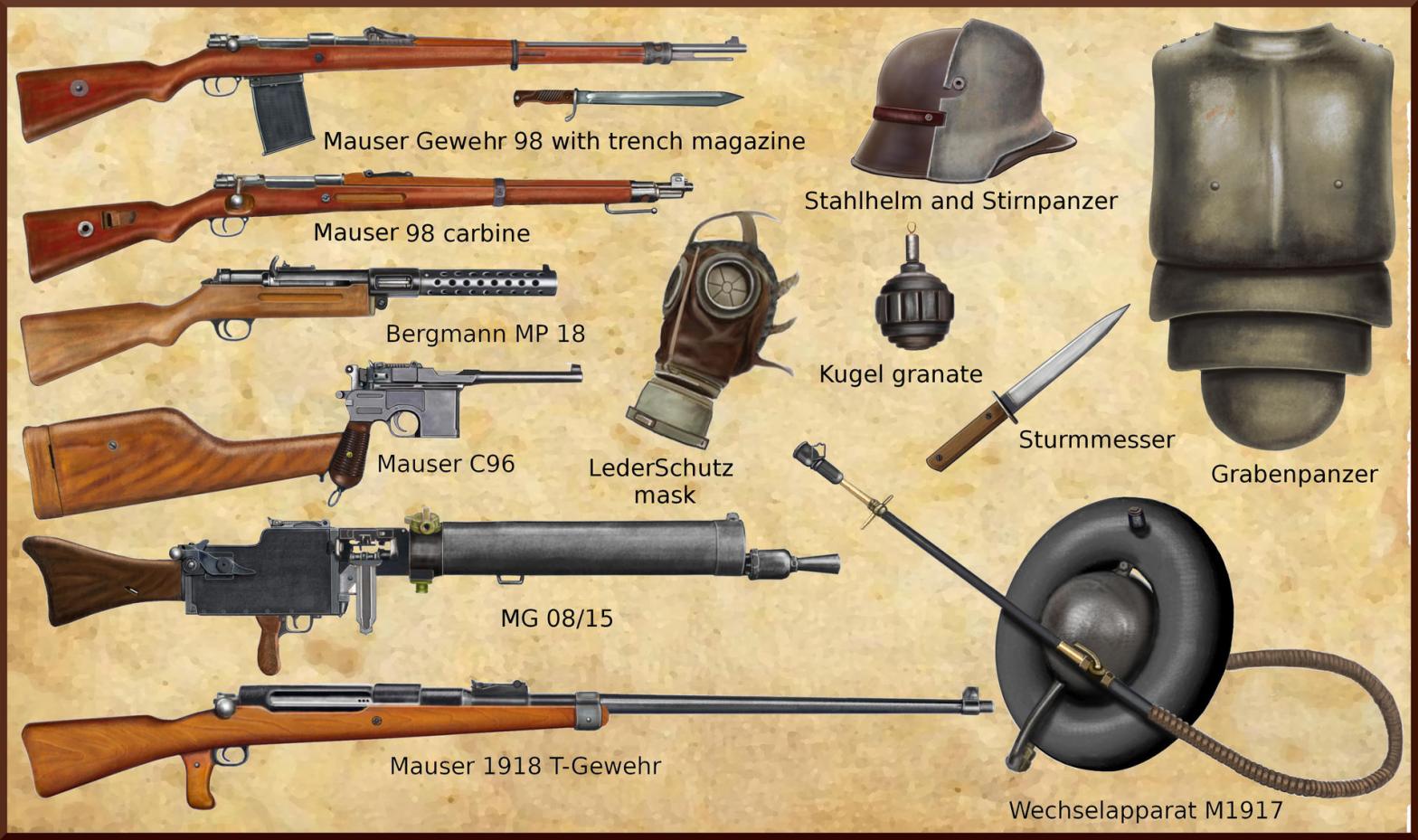
World War I relied on the technological and tactical advancements of the
late Empire wars, notably the Crimean War for Western Europe. History
often overlooks the hidden war (Times UK daily news before 1914)
between the terrestrial empire of Germany – too large for Europe but too
small for the world – and the thalassocratic English empire. This war
originated from the quick changing energy sources for land and sea vessels
from coal to oil.
Oil is necessary for airplane combustion engines and is a more
practical form than coal as it is liquid, more easily storable, and
manageable.
Germany, in partnership with Turkey, created a new transcontinental railway line
dedicated to freight and oil transport: the Bale-Baghdad.
The largest transeuropean railway circuit was an underappreciated
element of the first world conflict. This route led to a low-intensity
internal struggle between the two empires. This new energy source,
along with Germany’s coal and iron ore resources in the Ruhr, gave
it an advantage in industrial production. They were already the
leading industrial chemists of the early century.
There were many destructions during its construction, which were acts of
sabotage supported and fueled by the countries traversed that no longer tolerated
the Ottoman Empire. This was a blessing for clandestine actions under false flags.
The aftermath is well-known, with the Ottoman Empire being the first to fall at
the end of World War I.
During World War II, the use of radio and radar applications transformed
communication, coordinating both weaponry and intelligence.
The first specialized calculators changed warfare by improving both firing
controls and aeronautical designs. The development of proximity detectors
altered both aerial warfare and defensive forces. These applications were
further improved post-war, including infrared technology already tested
with binoculars on the German side.
The resistance warfare in Europe and worldwide took on significant importance
during the second war, as did the policy of both Axis and Allied camps to practice
the destructive onslaught of civilian sites. - The warfare of this generation will be an extension of the principle of
resistance, including low-level warfare. This will be proxy warfare and what is
hypocritically called international terrorism. It’s exclusive civilians’s victims.
This form of war is not conducted through a declaration of war and a
battlefield. The advantage is to carry out short-term, impactful actions
that are also psychological attacks on populations. It is not necessary to
know the instigator; we enter a pseudo-random state where financing and
commitments are like Russian nesting dolls. The continuity of the conflict
and its intensity will vary. This form of war involves creating a narrative
and being relayed by the media. The goal is to spread fear, maintain
anxiety, and create a constant threat.
Since the end of World War II in Europe, the preferred form of war has
been the ‘stay-behind’ operations like the Gladio group in Italy, which
played a major role in political destabilization.
Groups like the Muslim Brotherhood, ISIS, Al Qaeda are involved in these
practices and this form of warfare. As for collusion and sponsorship,
Senator Hillary Clinton has been very clear about the U.S. use of these
groups. It’s a form of low-intensity civil war, a threat diffused throughout
the social body and civil infrastructure. These are attacks directed
specifically at civil society and aim at violent engagements that target
transportation networks, festive gatherings, and particularly large crowds.
The intent is to terrorize as many people as possible through sporadic
actions.- This last form is an extension of the preceding since it is exclusively oriented
towards information and manipulation of individual and social group thought.
We enter a realm that includes what is called large-scale psychological
warfare involving all media, aiming to manipulate social networks and thus
the social body.
We’re talking about cognitive warfare, social hacking, brain hacking. Work
is done cultivating reasoning biases, cognitive biases, and truncated
information. Here we find all the manipulation tools used in propaganda
and destabilization conflicts.
Continuous information bombardment: no time to reflect.
Contradicting information.
Authority arguments via chosen or self-proclaimed experts.
Narratives chosen and disseminated by all media.
Instant social networks used to disseminate and critique, if not refute,
critical arguments.
Politics of censorship through these networks, preventing discussion and
critical argumentation: Twitter – Facebook cases.
State-coordinated policies of both harassment and either legal attacks or
resource attacks: the CTI League documents case. The important current
data are visible yet long underestimated – the use of drones powered by
electric energy, the new holy grail if it can be stored at high intensity.
3D printing allows for the production of all necessary parts for objects and
complex components.
The rise of law-tech with the use of cardboard and wood is coming back
strongly as we are in a generalized principle of asymmetric warfare.
Adaptations to the flow of positive and negative results are faster (see the
Ukraine war).
The miniaturization of both electronic chips, electric motors, and energy
sources is part of a fundamental wave that the armies seem to be
discovering because adaptation and polymorphism of objects and
strategies are once again paramount.
AI is also used for simulation, and learning will follow; however, for
military robotics, the cost is decreasing but the performance requires
heavy investment. By this last description, which has its counterparts in
the civilian world, including the police, we can see a radicalization of social
control, thought, and public action. There is an expected civil war, but it is
already happening because all social spaces are under surveillance and
subject to coercive
By this last description, which has its counterparts in the civilian world, including
the police, we can see a radicalization of social control, thought, and public
action. There is an expected civil war, but it is already happening because all
social spaces are under surveillance and subject to coercive actions.
- This last form is an extension of the preceding since it is exclusively oriented
 It' s me "Benoît " !